
Development and HIL Validation of a Low-Cost Two-Level Control Strategy for HVAC Systems |
|
Jesús Clavijo-Camacho(1), Álvaro de la Cruz Álamo(1), Gabriel Gómez-Ruiz(2), Cristian Díaz-Martín(2), Juan P. Torreglosa(1), Reyes Sánchez-Herrera(1) 1. Department of Electrical, Thermal, Design and Projects Engineering, University of Huelva
2026-06-27 |
 |

Abstract
Buildings account for a substantial fraction of globalfinal energy consumption, with HVAC systems representing their dominant load. The progressive deployment of dynamic electricity pricing creates a strong economic incentive to shift thermal loads toward low-price periods; however, implementing optimization frameworks on low-cost embedded hardware remains largely unvalidated experimentally. This paper presents the design and 24-hour experimental validation of a two-layer hierarchical control architecture for HVAC systems targeted at resource-constrained embedded microcontrollers. The upper layer consists of a rolling-horizon dynamic programming optimizer computing a global binary on/off schedule over a 24-hour planning horizon, while the lower layer implements a real-time safety controller enforcing hard thermal comfort constraints at every control cycle. The architecture is validated through a hardware-in-the-loop platform, in which the microcontroller exchanges signals with a first-order RC building thermal model on a real-time emulation target. Results demonstrate a total electricity cost reduction of 19.71% relative to a conventional hysteresis thermostat, with indoor temperatures maintained within the prescribed comfort band for 98.8% of the trial duration, confirming that cost-optimal thermal management is achievable on severely resource-constrained hardware.
Key words: Hardware-in-the-Loop, HVAC Control, Dynamic Programming, Embedded Microcontroller.
Published in: Renewable Energies, Environment
& Power Quality Journal (REE&PQJ) |
|
| ISSUE: Vol. 26. No.1 | Pages: 129-134 |
| E-ISSN: 3020-531 X | Date of Current Version: 2026-06-27 |
| REF: 251-26 | Issue Date: 2026-07-15 |
| DOI:10.24084/reepqj26-251 | Publisher: AEDERMACP/ EA4EPQ |
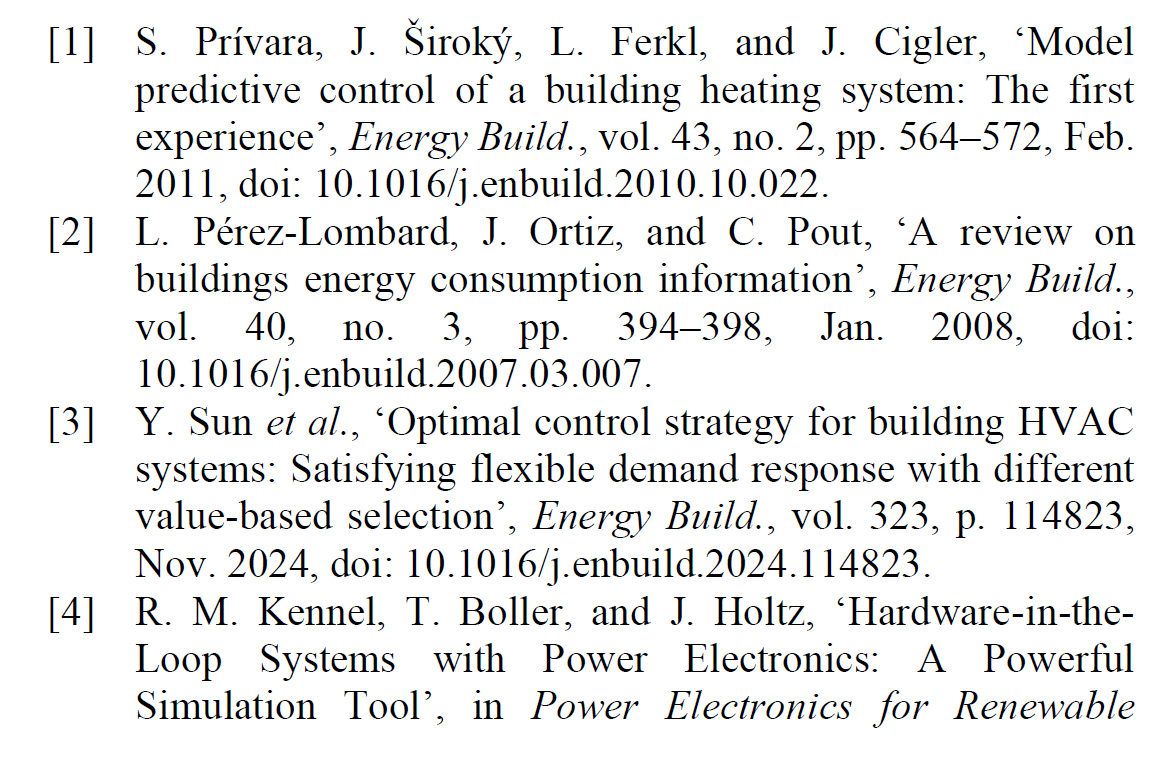
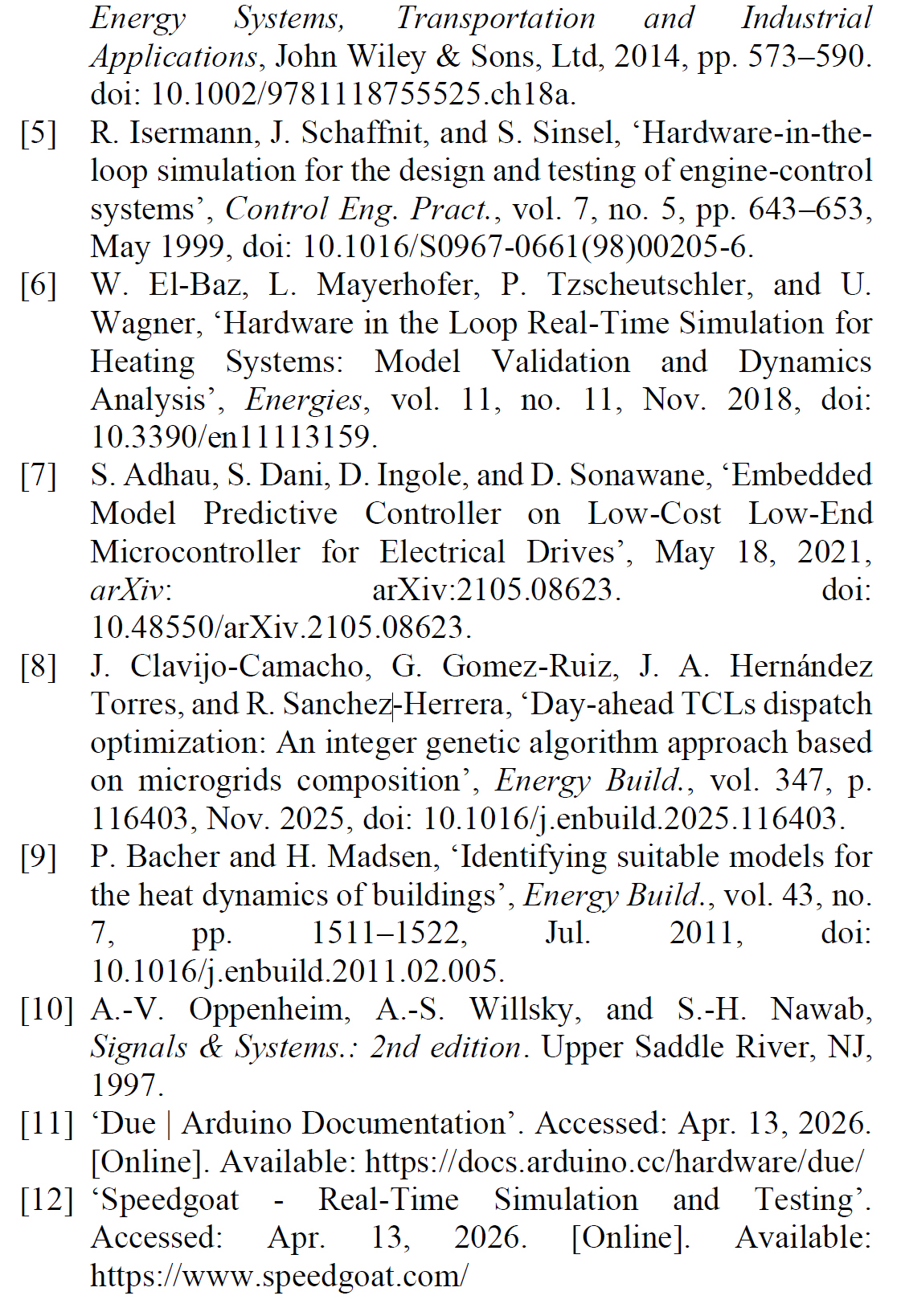
References


|